In the previous sections, you learnt about tools that can be used to challenge negative thoughts. On this page, I will share with you a simple method to increase a tool’s effectiveness.
The method involves adding one simple step, called “Stop,” before challenging the thought, and another, called “Ignore,” after. Right now, of course, the additional steps will mean little to you. In the next sections, I will explain them clearly.
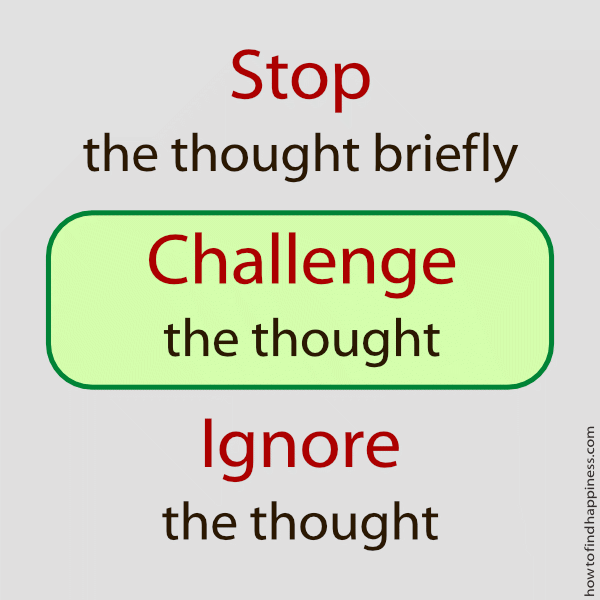
I will now use a simple example to explain the “Stop, Challenge, Ignore” method. Let us imagine that you detect, in your mind, the negative thought that your best friend is “all bad” just because she forgot to reply to a text message you sent her. (i.e. a black-and-white negative thought). As soon as the negative thought is recognised, you can go through the sequence, “Stop, Challenge, Ignore” to deal with it. I will explain these steps now.
Step 1: Stop the thought briefly
In your mind, many thoughts, including negative ones, are constantly “moving” around.
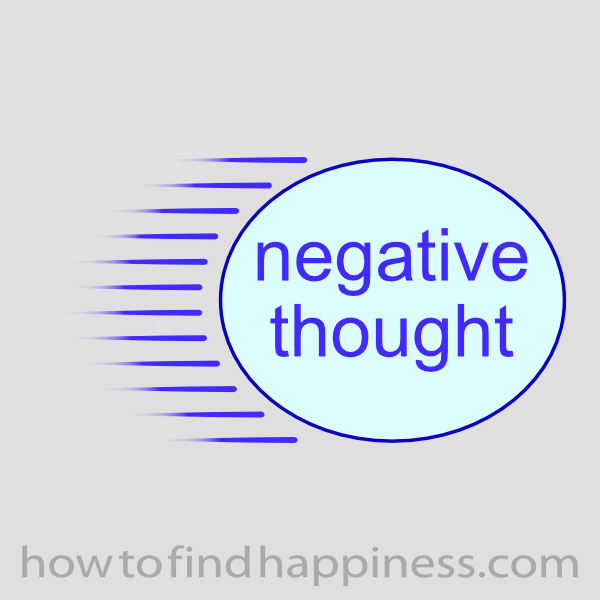
When you notice a negative thought in your mind, to deal with it effectively, you first need to stop it from “moving”. That is, you need to make the thought “stationary”
Holding the thought still helps you to engage with it. It’s a bit like when a child is running wildly around a room; to talk to the child meaningfully, you need the child to stop running and become still. In the case of a child, you may shout her name, for example, “Shelly!”, and this would, at least briefly, cause her to pause. Once you get her attention, you will be able to engage with her and say something like: “Shelly, it’s time for dinner!”

So, in a similar way, how can you make a thought that is speeding along in your mind come to a standstill? The answer is to use your inner voice. As soon as you sense a negative thought occurring in your mind, you can use your internal voice to say as firmly as possible, “Stop!” What this does is to temporarily “freeze” the thought, so that your mind can engage with it.
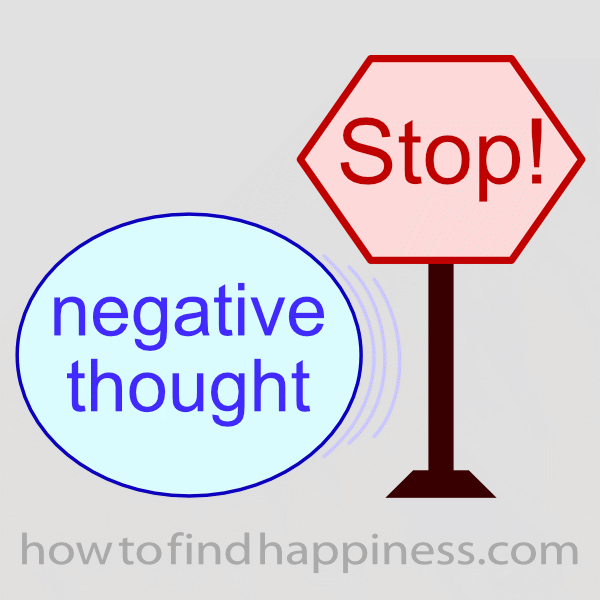
It is essential to appreciate that using your inner voice to say “Stop” does not permanently stop negative thoughts. It is well known in psychology that merely saying “Stop” does not permanently stop thoughts. Therefore, in the “Stop, Challenge, Ignore” method, the word ‘Stop’ is used only to briefly pause the thought, just enough to engage with it.
So returning to the example, as soon as you sense that you are having the black-and-white thought that your friend is all bad, you say to yourself, “STOP”. This inner voice command briefly holds the negative thought in place while you move on to the second step, “Challenge”.
Step 2: Challenge the thought
Now that the negative thought has been made stationary by saying “Stop”, you can proceed to the next step, which is “Challenge”.
In this step, you use a tool you have already learnt about, such as “naming the thought”, to challenge the negative thought. Continuing with our example, you can say, in your inner voice, “This is a black and white thought.” As explained in a previous section, naming a negative thought brings it into your awareness, which weakens it.
Now that the thought is weakened, it’s time to move on to the final step, which is “Ignore”.
Step 3: Ignore the thought
You are now in the third and final step: “ignore”.
So far, you have briefly stopped the negative thought using the word “stop” and then challenged it by naming it. Now, in this final step, you would want the now weakened thought to “go away”.
However, a fundamental concept in psychology is that trying to push a thought away can make it worse, as it will reappear with even greater strength. I can demonstrate this concept right now with a simple psychological experiment.
Here is the experiment:
“Please do not imagine a cat drinking milk.”
Well, that was the experiment! I just asked you not to imagine a cat drinking milk. But I bet you imagined a cat, even though I told you to do the exact opposite! This brief psychology experiment illustrates how, when you attempt to suppress a thought, it often resurfaces and becomes more prominent.
Luckily, there is an alternative way to make a thought disappear. You just need to “ignore” the thought. Ignoring means that, while you are aware that the thought is there, you do not engage with it. Eventually, the weakened thought will fade away on its own. Ignoring is very different to suppressing a thought. By ignoring, you are not pushing the thought away. Instead, you are saying, “I know the thought is there, but I am not going to interact with it”. A thought that you do not engage with will disappear. It’s a bit like, if you have a colleague next to you who is irritating you, a good way to get rid of her would be to ignore her.

Eventually, your colleague would get bored and leave on their own. Negative thoughts are similar in that when ignored, they tend to go away.

I must stress that ignoring is very different to suppressing a thought. By ignoring, you are not pushing the thought away. Instead, you are saying, “I know the thought is there, but I am not going to interact with it”.
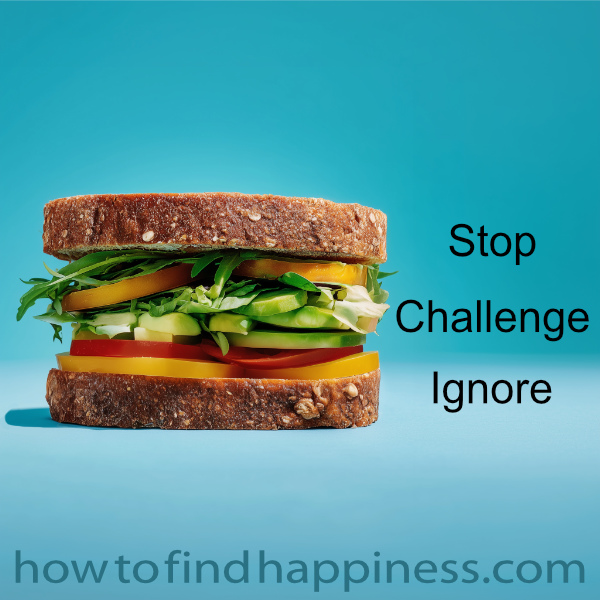
You can think of “Stop, Challenge, Ignore” as a three-layer sandwich. The top bread is the Stop part, and the bottom bread is the Ignore part. The middle is the tool you choose to challenge the negative thought.
In the first instance, the “Stop, Challenge, Ignore” method may appear to be “lengthy”. That is only because I broke it down into individual steps. While it may take a while to read and understand the steps, in practice, the method takes only moments. And, like everything, with a bit of practice, it will become quicker. Eventually, you will find yourself using it almost automatically.
In the above discussion, I used the “naming the thought” tool to weaken the negative thought. The stop, challenge, ignore method can be used with the other tools as well.
Each time you use the “Stop, Challenge, Ignore” method, you are “educating” your mind. For example, when using the “looking for evidence” tool, you train the mind to think logically. Over time, your mind will change how it thinks, leading to fewer negative thoughts. Please have a go at using this method. It will take a little while to get used to it, but once you do, you will find it very effective in dealing with negative thoughts.